Smiling Clare

Living Life, Within the Limits of Chronic Illness

FutureLearn: Developing Your Research Project Weeks 3 & 4

Approaching the halfway mark of this course and I have to say I’m learning loads!

In the third week we covered actually starting research and the different sources available; including primary and secondary sources, academic journals, broadcast media and datasets. Most of which I already had some knowledge of from my studies with The Open University. Yet I found it useful to reinforce that knowledge.

We also covered ways of recording your findings, making it easier when it comes to referencing the sources at the end of your project. Something which I admit I tend to struggle with as I have no consistent way of noting down my sources; they tend to be jotted down here, there and everywhere so locating them when I need them can be rather bothersome! But I always manage it somehow. Hopefully using the checklist provided from this course, and the other stuff I’ve learned, I’ll be able to be a bit more organised in future.

Exploding out search terms was also covered, which I found quite interesting too. This is where you identify other words with the same meaning as those in your search terms, as well as related words. Then you can use all these combinations to effectively search the internet for information on your topic. This is something I’ve used a lot over the years without even realising it.

In week four we covered research methodologies. This is where I found things got a little tougher. Methodologies are the system of methods used for your research, there are many different types, mainly falling into two broad categories of quantitative methodologies with facts and figures behind the findings and qualitative methodologies which are more contextual.

The reason I think I found this fourth week tougher is because I still only have a rough idea for my project. I’m doing this course in preparation for my next Open University module which is a project, but right now I still have no real definitive idea of what the specifications for this project are so narrowing down my research question and identifying the methodologies best suited to answering that research question is difficult. I’m doing my best to complete this course and give it as much attention as it needs but I can’t throw myself into a research project just for the sake of it, not with my health the way it is. I’m hoping that even with just a vague idea for a research project I’ll still be able to complete this course and it will help me when the time comes to complete my project.

As I write this we are nearing the end of week 5 on academic reading which I still haven’t had a chance to start. Catching up again as usual!

Current and future runs of this course are available here: https://www.futurelearn.com/courses/research-project-3/details

Share this:

FutureLearn: Begin Programming: Build Your First Mobile Game

So back on June 1st 2015 having just finished my Open University module I signed up to this course for a bit of fun, then discovered a whole host of other courses which interested me…and signed up for a few more later in the year too!

This course took me back to the first love of my degree, the thing I really would have liked to focus my degree on: coding. Sadly with my health the way it is I couldn’t cope with the assignment deadlines, I was coding on the computer most days, dreaming about solutions at night and getting immensely frustrated when I couldn’t work out why the code wouldn’t work as it should! Combined with a relapse which meant I couldn’t spend too much time on the computer, I diversified my degree to include business and focussed on modules that complemented that; this meant little or no coding.

I found myself going back to those days of dreaming of solutions, and getting frustrated when the code didn’t work, but without the pressure of solid deadlines (it doesn’t matter if you fall behind on a FutureLearn course since you can always catch up and there’s no deadlines set in stone) I thoroughly enjoyed this course. I learned a lot and refreshed my memory of the basic programming rules.

The IDE used, Android Studio, was easy to install and use especially with the guidance provided via the videos on the course. Getting the emulator to work was however more of a challenge. It took me many hours, over several days, using different computers to discover that one computer didn’t support Virtualization Technology and then I had difficulty getting the emulator to launch on a second computer but by creating a user variable ANDROID_SDK_HOME and setting its value to D:UsersName.androidavd after about two weeks I finally got it working!

Building the game up week by week was fun and very useful in improving my confidence in the coding. It was nice to reach the end of each week with a (mostly) working game. I loved playing around tweaking some of the settings, layout and appearance. For example I changed the background colour from green to purple, just because I wanted to see if I could.

My finished game by the end of the course

That’s not to say this course didn’t have it’s drawbacks. I was always reluctant to do more than instructed on the videos because I knew by the end of the week I’d have to backup my code and revert to the code version issued for that week, thus eliminating the changes I’d made unless I reverted to my version and tried adding the extra bits I learned as I progressed through the course. This is something I would have loved to do but due to the screentime constraints I live with, it wasn’t possible. Hopefully it’s something I can play about with in any future spare time at the screen!

The support if something went wrong or didn’t work as it should, was hit and miss; sometimes you’d get a lot of responses both from the course leaders and other learners, other times you’d be searching your way round google trying to find an answer on your own. I realise everyone probably did there best but it could leave you feeling like you’d been thrown in at the deep end and were scrambling about for answers hoping one of them would actually work.

I think an actual beginner may have a hard time with this course but that’s not to say they shouldn’t give it a go! If you’re really interested in coding then this is a really good way to get started, but it can feel like you’ve been thrown in at the deep end with a new program and programming language to learn. 

Overall it was a great course and like I’ve already said, I really enjoyed myself completing it. It has enforced my understanding of Java and introduced me to a new IDE in the form of Android Studio. It has also wetted an interest in developing Android Apps, something which I had been vaguely interested in but that interest has now increased thanks to this course!

Future runs of this course are available here: https://www.futurelearn.com/courses/begin-programming

Share this:

For Anyone Who Uses The Family Bathroom…

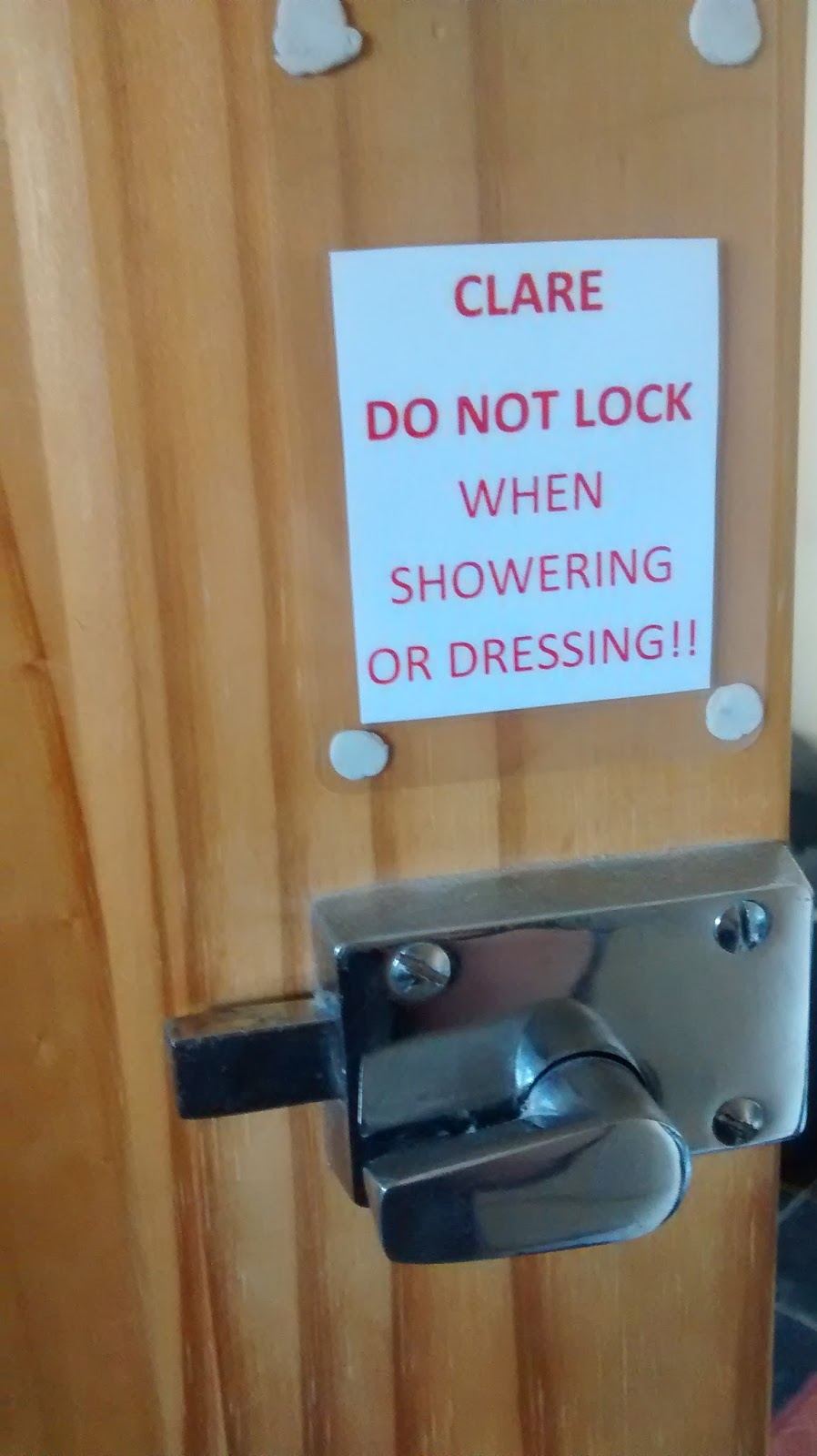
…I feel I should explain the notice above the lock on the door.

It was an idea that came about from a friend a few weeks ago, after many close calls of me almost falling and the odd false alarm where my family thought they’d heard me calling for help but I’d been perfectly all right.

You see one night when I wasn’t particularly steady on my feet (well less steady than usual, that is) I decided, since I was in need of one, I’d have a shower. To be on the safe side I told my family I wouldn’t lock the door, ‘just in case’.

At this point I should point out the lock on the bathroom door is one of those which, if necessary, can be unlocked from the outside for such eventualities but not locking it means there’s less delay.

Anyway I went in the bathroom, got in the shower and a few minutes later heard a banging noise over the sound of the shower. I opened the shower door to find my Mum trying to open the locked bathroom door (thinking it was unlocked like I’d said it would be) because she thought I’d called for help. Dad was trying to find a coin or screwdriver to undo the lock with when I unlocked it, saying I hadn’t called and was fine. But I felt guilty for sparking such a panic, and for saying I’d leave the door unlocked but automatically locking it when I got in the bathroom.

That night I told the M.E. community on social media about this and one friend suggested putting a notice on the door saying ‘Do Not Lock’. Obviously being the only bathroom in the house we thought this might be a little non-specific and people would perhaps think they weren’t allowed to lock the door either. However the idea was in the right place and so the laminated piece of paper, white-tacked to the bathroom door was born.

The sign above the lock on the bathroom door

It reads “CLARE DO NOT LOCK WHEN SHOWERING OR DRESSING!!” It was made that specific so in times of very poor cognitive function I know I can lock the door at other times. I’m only really in danger of falling or getting into difficulty when showering or getting dressed, and I always make sure everyone in the house knows I’m in the bathroom at those times. It’s slightly odd announcing to the house that I’m going to get dressed or have a shower but right now it’s necessary; it also means they’re on alert for me calling should I find I can’t manage myself or get into difficulty.

The best bit about this notice is IT WORKS. Since putting it up there have been a number of times I’ve gone in the bathroom to get dressed or have a shower and I’ve automatically locked the door, then read the notice and unlocked it ‘just in case’. Fortunately there haven’t been any times when I’ve had to call for help because of a fall, however I do frequently call for help with drying the lower half of my legs and getting my trousers on. It’s just one of those things I can’t always manage by myself right now.

As well as explaining the point of this notice to anyone who thinks it slightly odd, I want this post to serve as a thank you to the wonderful person who suggested the idea. And if anyone else has similar problems perhaps this idea could help you too.

Share this:

Television Woes

Most days I can’t watch TV past a certain time of day, usually 8 or 9pm. Especially but not exclusively if I’ve watched some during the day. Time at computer screens also seems to impact on my ability to cope with the television.

This is a difficult aspect of M.E. to explain. Most people sit down, turn the television on and watch a good program classing it as a restful and relaxing activity. But when you have M.E. that isn’t the case, in fact sometimes it can hurt to have the TV on.

And this is what I am finding at the time of writing. It reaches a certain point in the day, well more accurately evening, and I can’t stand having the television on. It physically hurts my eyes and head to watch it, or even be in the same room with it on. It’s almost like my brain can’t cope with the moving images and flashing lights that come with having the television on, in short it makes me feel a lot worse and so I avoid it.

This means the online catch up services have a steady demand from me during the day as I catch up with the shows I want to see but am physically unable to watch in the evenings. You see for some reason, seemingly unknown to me, I can cope with the TV during daylight hours. However once it starts getting late and the light changes it’s a different story. Whether it is the lighting; natural light making it easier to cope with the flashing lights/images of the TV or whether I just reach a point of exhaustion which means my brain literally just can’t cope with it I don’t know, I can only guess.

I’m currently awaiting new glasses, adjusted for my astigmatism, and I’m hoping they might help; perhaps it’s just my eyes having to work harder and getting tired that causes the problem. Like I say I really don’t know what the cause is, I just know it’s immensely frustrating not just for me but also for my family, since I have to leave the room most nights if they have the TV on past a certain time, other nights I can cope. It all seems to depend on what I’ve done that day and how long the program is on for.

Why am I writing this post? In an attempt to explain something I’m facing everyday, to make people more aware of every aspect of M.E. even the one’s which seem most unusual and difficult to explain.

Share this:

Page 29 of 61

Powered by WordPress & Theme by Anders Norén