Living Life, Within the Limits of Chronic Illness

Category: My Open University Journey Page 6 of 16

Introducing Brian…

It’s been said that every student needs a study buddy. I think this is especially true for students of distance learning like OU. It can be a lonely business studying alone at a computer and keeping motivated can be quite a challenge. That’s where a study buddy comes in. Even if that study buddy isn’t another person, or even a living being.

If you’ve been following me on Twitter or are my friend on Facebook you will already have heard of and seen my study buddy Brian. He was bought for me by my best friend when I was struggling during my previous module and I don’t think there’s been a day I haven’t given him a cuddle since I got him! Even during my current summer holidays.

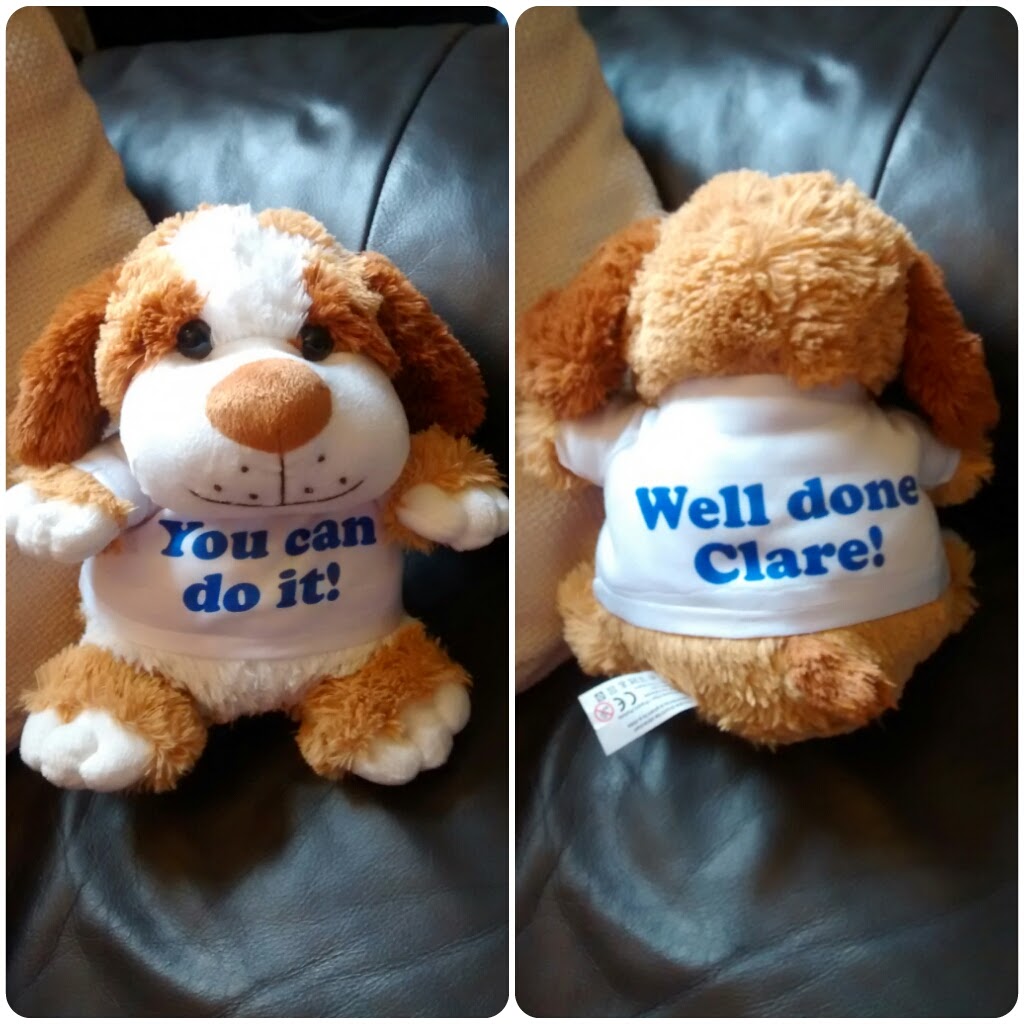
You see Brian is a stuffed toy dog. A gorgeous stuffed toy dog. With a fantastic T-shirt. He’s there to encourage me when I’m struggling with studying, to celebrate when things go well and comfort me when things don’t go to plan!

So here he is:

Brian my study buddy.

Now I’m sure you can see why I’m so attached to him! He really is the cutest, best present I think I’ve ever been given! His T-shirt is so encouraging, I’ve taken to keeping him about in my summer off especially when my health gets tough. Taking photos of him doing everyday things and helping create a study area ready for October, yes I’m actually having a desk and desk chair. Hopefully I’ll be well enough to use it, but if not the sofa is always there as a back up plan. With Brian’s help I’m sure I’ll find a way! I’ll leave you with a few more photos of Brian:

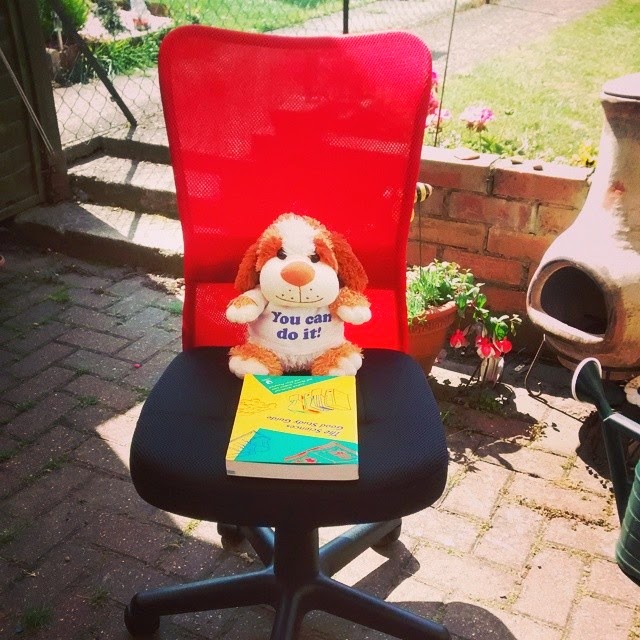
Brian sitting in my deskchair where we built it on the patio!
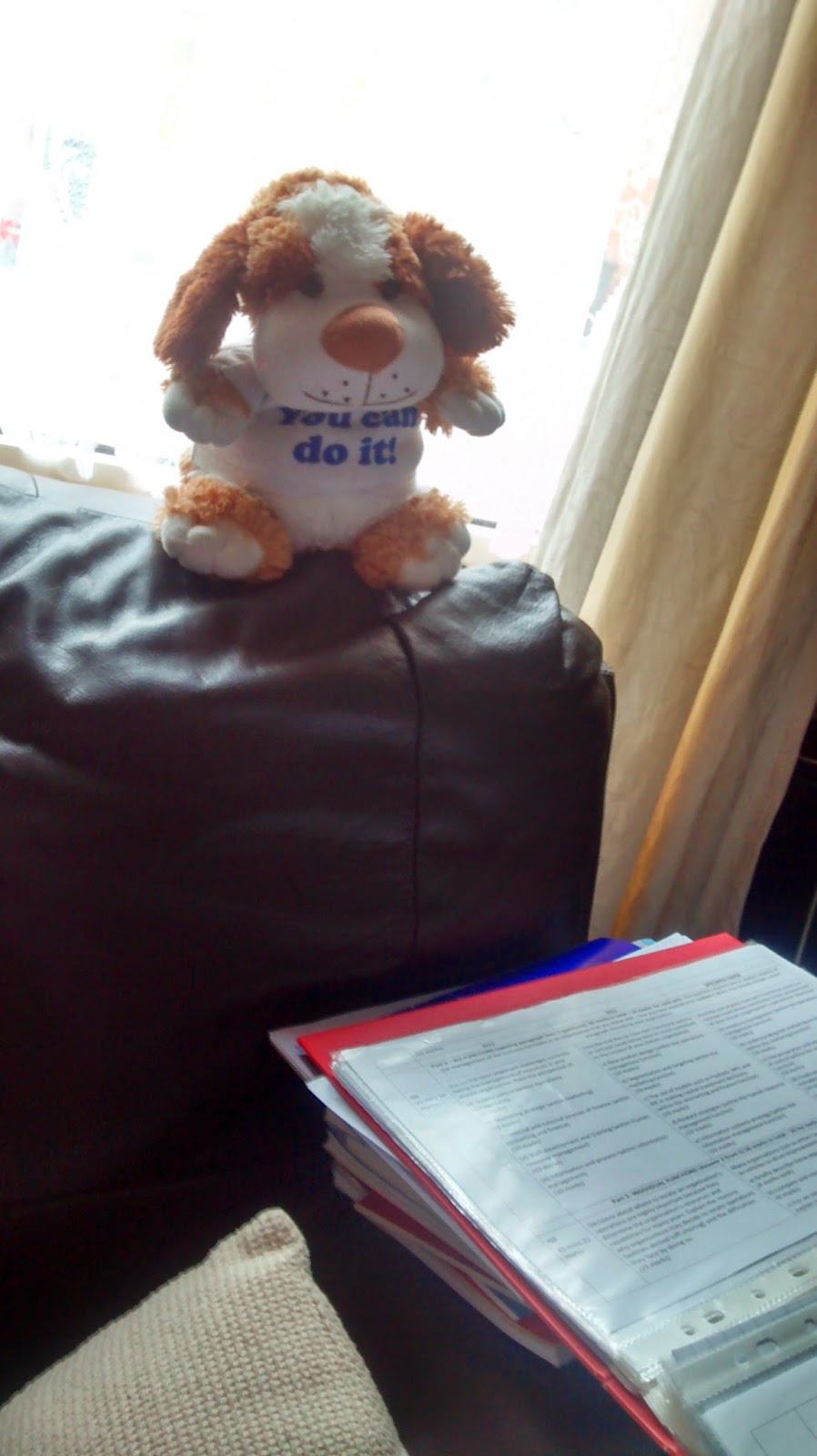
Brian supervising my revision back at the end of May 2014
Share this:

Exams with OU

So I can’t remember if I’ve mentioned about the exam arrangements available if you have declared a disability or chronic illness when studying at The Open University. If I have this post is somewhat of a repeat but if not…well here you go:

I recently sat my first exam with OU and was very nervous about it to say the least. The pressure of having to be well enough to think on a particular day is probably unimaginable to those who don’t have a chronic illness. Actually that’s probably a lie, pretty much everyone gets nervous and feels under pressure when it comes to exams they want to do well in, but with a chronic illness like M.E there’s an added pressure of not knowing how well you’re going to feel, and then there’s the fact pressure can make this illness worse. A tricky situation if ever there was one!

Anyway OU have been amazing at helping me with my exam needs. I can’t write for long, concentrate for long periods and travelling exhausts me. So what’s the solution? Well an exam sat at home, on a computer with extra time and rest periods of course!

Just because you have a disability or chronic illness doesn’t mean you can’t sit exams and get a degree. I’m proof of the former (as I’m sure many people are) and I’m on my way to proving the latter!

So how does it all work?

Well I had to declare my illness as a disability with the OU and request special exam arrangements. When I first started at OU I mentioned I had ME/CFS and I’d explained I’d probably need additional arrangements for my exams. I was told that I’d have to request this early on during a module with an exam in order for the arrangements to be put in place.

Until October 2013 I had no modules with exams, they were all EMAs. But for B203 I had to put the arrangements to the test. I got an email about three months into the course asking me to complete an online form stating what additional arrangements I thought I’d need and they’d see if they could accommodate them. I’d need a letter from my doctor confirming my illness and explaining how it affects my ability to sit an exam. I essentially had no idea what would help, although my Disabled Students Allowance needs assessment had given me a few ideas; the use of Dragon Naturally Speaking software was an option, as was sitting the exam at home, extra time and rest breaks were also mentioned.

In the end I decided I could manage to type for the exam period, although Dragon Naturally Speaking software does come in useful I don’t use it that much – I need to train it more and haven’t had the chance during my courses, besides sometimes I find talking more exhausting than typing even though typing can hurt! So on the form I asked to sit the exam at home, on the laptop provided to me through DSA using Microsoft Word and with extra time and rest breaks. The most difficult part I found was deciding how much extra time and rest breaks I’d need. In the end I settled for 45 minutes for each. There was also the option of stating any times you are unable to sit an exam due to your disability, I used this to say when my concentration is usually at its best; after 11am but before 5pm.

Thankfully this was all accepted and that was how I was allowed to sit my exam. It started at 11:30am and would finish at 4pm unless I completed it earlier. The invigilator would come to my house and the exam would be sat in my living room. That was some pressure off me!

On the day itself I actually used all the rest time allowed, and realistically could probably have done with a little more – something I now know for next time – but I didn’t use all the extra time for answering. I finished with 30 minutes of the time I had allowed to spare. Not a bad thing as it gave me time to check my answers over and make any necessary changes.

Although my answers were all typed on the computer and saved to a USB flash drive provided by the OU, I had to print a copy of my answers off to submit with the exam paper. This was easy done, although I was a little worried as me and the printer don’t always have the best working relationship!!

All these additional arrangements made it possible for me to sit the exam on my module, without them I don’t think it would’ve been possible. After about half hour of writing by hand my writing becomes almost illegible; even I struggle to read what I’ve written let alone anyone else! My concentration tends to be long gone after an hour of continuous thinking, so rests are essential, they allowed me to pace myself a little – this doesn’t mean I didn’t suffer after the exam (I did) but I’m certain it lessened the severity of the symptoms I experienced. Sitting the exam at home removed the need to travel, something I find exhausting at the best of times; I haven’t really left my home county for years, and only venture to surrounding towns on occasion. In fact recently leaving the house to go anywhere that might be busy has been a rare occurrence because I have been so unwell.

Anyway I’m hoping sharing my experience of sitting exams with the OU will help others with a chronic illness who are considering studying. It can be done. I can’t deny it is tough, incredibly so at times, but with the help and support of friends, family and the place you’re studying at it is possible! So whatever you do don’t give up!!

Share this:

Module Results…!

I didn’t really expect to be writing this post so soon but my module results have been released early so here I am.

So I passed B203 Buness Functions in Context. Just. By 3 marks. There was only those three marks between a pass and a resit. I can’t deny at first I was devastated. There was a 30+ percentage point drop between my exam result and my overall coursework score (OCAS). I was in tears. I knew I had passed, and done so under tremendously difficult circumstances but I couldn’t believe how close I’d come to failing. And as always there was a part of me questioning if I’d been well, would the result have been much better?!

But then I remembered the circumstances I’d been revising in. How much I’d been struggling. How close I’d come to giving up entirely. After a few hours contemplating that, I began to feel happier. I’d passed. There was no need a resit. The course books could be put on a bookshelf ready for reference in the future if needed. I could relax and enjoy my summer off. I’d done my best under what would’ve been difficult circumstances for anyone but harder for someone with a chronic illness like M.E. I should be proud of what I’d achieved. So I am.

I found it was so easy to forget how much I was struggling during the revision period. Not only did I have my chronic illness to cope with but I was dealing with the loss of my Grandad and his funeral. I think I mentioned in an earlier post that if it hadn’t been for friends and family talking me round I would’ve given up on my degree entirely, it all seemed too much. Looking back and reminding myself of this I realised passing was a major achievement. So it’s not the best grade in the world, but it is a pass. And that is what’s important.

Over a few days I’ve realised the significance of managing to pass what everyone had described as a difficult module, under the circumstances I was in at the time. Yes I had hoped and dreamed for a better result. But like I said it is a pass. And that is all that matters. Being a perfectionist at heart accepting this doesn’t come easy but I slowly am. I received some wonderful supportive messages from people on Facebook and Twitter which were all much appreciated and got me through the tough times during results day. So if any of you are reading this, thank you. Those words meant the world to me.

To anyone else struggling to come to terms with an exam result that was worse than expected, don’t worry about it. What’s done is done. If you failed and you’re offered a resit spend the time revising and know you can do it. Someone somewhere will always be rooting for you. And if you’ve passed but not received the grade you expected, wanted or dreamed of it’s not the end of the world. It may well feel like it but it’s not. Focus on the fact you passed. You can put those course books away and move on to your next module or the next stage of your life. You did it. You passed. That’s all that really matters.

*If you’re unsure of any of the terms used here please look at the glossary page (link at top of blog) or comment if it isn’t listed there. I normally link any terms direct to the glossary page but I am writing this on a tablet and cannot do so.*

Share this:

My next module…

I don’t recall having mentioned that back at the end of April I bit the bullet and registered for my next module. I figured I might as well make sure I got a place on the module I want to do.

There’s a choice of six modules for the next step in my degree and despite vowing to steer clear of any modules that involve coding (particularly javascript) I’ve picked a module that has a fair amount of computing coding involved. T320 Ebusiness Technologies: Foundations and Practice. To me it sounded the most interesting of the six modules I could choose from. Plus it has the added advantage of having no exam; just an EMA at the end of the module.

I prefer EMAs to exams simply because there is less pressure to be well on a certain day for a specific amount of time. With an EMA I can work in my own time, when I’m feeling my best. It makes planning my time and energy easier.

So come October this year I will be embarking on the next step of my OU journey. My first Level 3 module. Back to a subject I love. A subject that can take quite a toll on my health. But I’ve decided to give it a go, I’m not aiming for a high grade pass…just a pass is enough.

You see I’m not worried about what class of degree I leave The Open University with. To get a degree while living with a debilitating chronic illness will be a massive achievement in itself. I admit there’s a part of me that longs to get the best class of degree I possibly can; and there’s a part of me that always wonders if I’d get better results if I wasn’t ill. However as time has passed and my health has deteriorated since starting my degree journey I’ve come to the realisation that persevering and managing to continue to study, despite being ill, is an achievement. Whatever the marks, a pass is a pass. I’m not doing this degree to help me in a career; it may have been my original intention but right now my health won’t allow it, instead I’m doing it for myself, to prove that I can do better than the single GCSE I managed in school.

Hopefully when the time comes and my health improves it will help me in terms of job prospects. If not, so be it. I’ve already learned an awful lot and put some of it to use in my everyday life. But it’s not just about that, it’s about the things I’m learning about myself in the process as well. At times it feels like I’m achieving the impossible and it makes the struggle worth it. The strength and determination I’m discovering within me, that is what’s proving the most useful to me at the moment.

Share this:

Page 6 of 16

Powered by WordPress & Theme by Anders Norén