Living Life, Within the Limits of Chronic Illness

Category: ME Awareness Page 4 of 13

What is a low energy activity?

If you’d have asked me that 10 years ago  I’d probably have said watching TV, having a shower, reading a book, doing homework, playing on the PlayStation. I’d also have said high energy activities were walking to school, going on the dance mat, walking into town, playing sports etc.


But I’d have been wrong; or at least I’d be wrong about what a low or high energy activity is for a person with chronic illness.


You see for someone with chronic illness even simple tasks can be classed as a high energy activity. Walking from one room to another. Sitting up for ‘long’ periods (sometimes a long period can be as short as 5 minutes). Showering. Dressing. Watching TV. Having a conversation. Using a computer. Drawing, writing, painting. Studying. Making a cup of tea. Making a quick snack. Knitting. And so much more.


Therefore low energy activities are hard to come by; listening to music, colouring in a colouring book, watching a DVD you’ve seen a thousand times before, texting a friend, lying out in the sunshine, listening to a TV show but not watching it. It’s hard to think of much else. If you have any suggestions please leave a comment!


This makes managing energy levels incredibly challenging; when most activities can be classed as requiring high energy it can be difficult to fill the day. Although it’s possible to do more than one high energy activity a day, in fact it’s often necessary to do so, it requires significant rest periods between them.


And by rest periods I mean complete rest. No stimulation. Deep, meditative breathing. Lying down but not going to sleep. Perhaps listening to some gentle music.

Managing a life with such limited energy while carrying out simple everyday tasks, let alone having some fun and achieving what some people wouldn’t even think about, is incredibly difficult. But for many of us it’s necessary. I hope by writing this it helps people understand just how difficult it can be to manage activity levels with such limited energy.

Share this:

A Royal Fundraiser with a Difference!

So it’s that time of year again; M.E. Awareness Day is fast approaching and I’m beginning to make plans for fundraising. This year I plan on fundraising for Invest in ME again by dressing as a Princess on May 12th, you might remember I did the same last year (I was a Princess for a day!). However I thought I’d try and mix things up a little this time round.

So I’ve had a thought, on my JustGiving page I shall start a story which anyone who donates can add a line to by putting it in the comments with their donation. I shall try and collate all the comments regularly, into the story so far on the JustGiving page, but you’re advised to read the comments by the donations before deciding on your line in order for the story to follow on from the last line. I think this could be rather fun and it’s something that’s a little different, I shall post the finished story after May 12th right here on this blog, with each contributor recognised in brackets at the end of their line of the story.

The great thing is YOU can take this story WHEREVER you want it to go, just by making a donation however big or small, and adding a line. There’s no obligation to add a line to the story you can donate just because I’m digging out a posh frock and putting on a tiara for the day, but if you want a bit of fun the option is there for you.

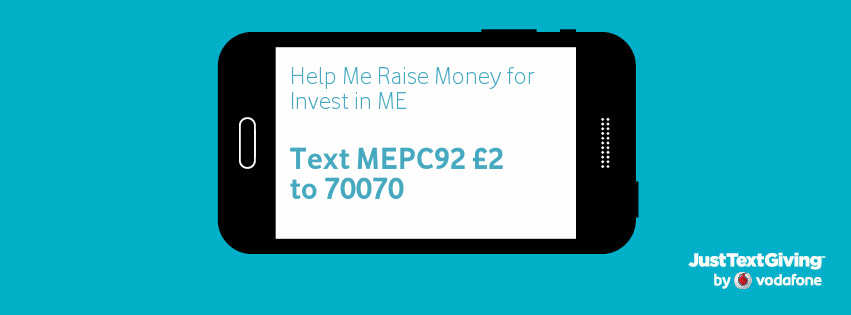
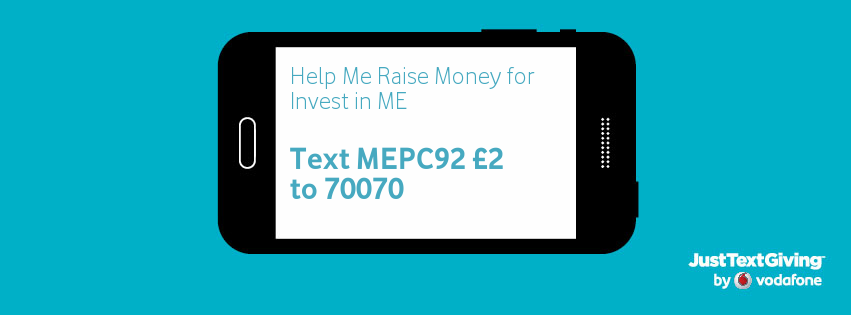
So please take part if you can, more details on how to donate can be found on my JustGiving page or you can text your donation by texting MEPC92 followed by your donation amount (£1, £2, £3, £4, £5, or £10) to 70070


Share this:

Yes Television Really Can Be Exhausting

Most people don’t think anything of sitting down in front of the television to watch their favourite program. In fact most consider it a relaxing activity, something they can do while having a rest after a long day at work.

Sadly with M.E. that isn’t the case. Television is actually a very stimulating activity, when you think about it there’s the moving images, the flashing as the light changes and the sound; that’s without having to filter out any conversation going on in the background which inevitably happens in family life.

All of this takes energy for the brain to process. Managing to watch the television in a silent household can be a challenge if you have M.E. At times it is impossible as the images move too quickly, the light from it is too bright or the change of images causes too much of a flashing effect. Obviously sound doesn’t have to be a problem as you have some control over that thanks to the volume control, but still if you’re watching TV with someone who prefers it on quite loud, sound can become another factor that makes watching TV a challenge.

As a result of this I have found it helpful to limit the amount of time I spend watching TV. I think on average the absolute maximum I can cope with is 4 hours; that sounds like a lot but when you’re unable to do much in a day except lie in bed or on the sofa that’s not much time at all. In fact if you think about the last time you got hooked on a boxset of programs, that’s probably what…four episodes? Somehow I suspect if it was a really good boxset you’d watch more than four episodes in a day if you had the time. You’d probably watch them back-to-back too.

I have to be careful and plan what I want to watch, if there’s something I really want to watch on TV in the evening but I’ve already watched four hours earlier in the day then that show has to be recorded or watched on the catch up TV services; recording it is preferred as then there’s no time limit on it’s availability.

Watching more than about four hours of television, or even watching four hours of unbroken television leaves me with a horrendous headache, increased noise and light sensitivity and at times very achey eyes.

So Yes Watching Television Really Can Be Exhausting.

Share this:

GET versus GET

I am in no doubt that this post will be a controversial one. It’s a post which risks a lot; it could be misunderstood. But it’s a post I feel I need to write. Before I continue I want to make a few things VERY clear.

I believe M.E. to be a physical chronic illness. I do not believe it to be all in the mind in any shape or form. I don’t believe it matters what it is called: ME, CFS, SEID, PVFS they are all just names for an illness with a wide range of symptoms no one really knows the cause of. I also do not believe Graded Exercise Therapy (GET) or Cognitive Behaviour Therapy (CBT) is the answer.

So why am I writing this post?

In essence it’s because I believe a form of graded exercise and even positive thinking can be beneficial. I’m not saying it’s a cure, far from it in fact, but I think it can help if done in the right way.

I did Graded Exercise Therapy in the early years of having this illness, and I can safely say the way it was implemented worsened my condition significantly. I trusted the doctors knew how to get me better; if a doctor said exercising would cure me I’d believe them and do it, anything if it meant I could be a normal teenager again. And I did begin a course of GET, that is until the physiotherapist put a stop to it as they saw my physical symptoms worsening. The exercise prescribed was too much; like running a marathon you haven’t trained for.

Now that form of Graded Exercise Therapy certainly isn’t beneficial for people with this illness.

However done in a different way I think graded exercise can be helpful, if not in aiding a full recovery, in aiding a partial one. I don’t shy away from exercise, but what I class as exercise and what a conventional person would class as exercise are probably two very different things. Exercise can be as basic as a few simple stretches done lying down, getting out of bed, walking to the bathroom, going down the stairs in the morning and back up them at night; it doesn’t have to be a walk round the block every day, or a five mile run.

Jumping straight into a walk round the block can inevitably worsen the symptoms of ME; the body hasn’t got the energy reserves it once had, hence the overwhelming fatigue, pushing through the fatigue to embark on exercise of that nature only serves to worsen symptoms. The trick is to start slowly, and build up gradually.

Starting some basic exercises; stretching, going down the stairs and back up them once a day, whatever seems appropriate, stopping before the overwhelming fatigue hits and sticking to that basic exercise routine for a week or two if no ill effects are had is a form of graded exercise I believe works. If ill effects are felt the level of exercise is dropped down a bit, if the routine can be kept up for two weeks without any ill effects look at increasing it slightly. One day at a time, depending on the symptoms of the day.

There are no set deadlines for completing the exercises, it’s simply a case of listening to the body. Any warning signs that the exercise is too much; for example worsening pain or fatigue, stop and try again the next day perhaps adjusting the routine slightly to make it achievable. Slowly but surely the amount of exercise that can be done builds up – gradually – and doing everyday tasks becomes easier.

A key thing to note is that some, if not all activities can be classed as exercise in some form; particpating in conversation exercises the brain and senses, walking to the bathroom, having a shower, even sitting up can be categorised as exercise with this illness; it all depends on the severity. They all use energy and any physical movement like walking to another room can be classed as exercise. It’s important to remember that; using all the energy in the body doing exercise, like I did when I did GET at the hospital, means there’s no energy for those everyday tasks that have to be done; you have to get to the bathroom somehow and it’s going to take energy!

I also believe positive thinking can be beneficial for people with this illness but again it’s not a cure. A positive mindset and belief that one day things will be better are key to not becoming depressed, entering a cycle of believing doing something will make the symptoms worse. I’ve noticed approaching things with a positive attitude does tend to lead to more positive results; even if the next day is a bad one, approaching an activity or whatever with a positive attitude and open mind leaves me with better memories of the day before.

Not going into an activity or situation believing I’m going to suffer for doing it is a tough habit to break, especially when the chances are the symptoms will worsen after doing it. But there’s no point in writing the story of the next day when we can’t predict the future. Of course there’s every likelihood the symptoms may worsen and the next day will be a bad one, but on the other hand there’s a chance it won’t be as bad as the mind is imagining.

Focusing on the present and not on the future can really help.

So there you have it. A controversial post which risks a lot. I honestly believe graded exercise and positive thinking can help in the management and recovery of this illness whichever name you choose to use for it. Perhaps not in the same way as it is implemented by physicians, and perhaps not in the same way as the research presented in the media suggests but in some forms it can help.

Share this:

Page 4 of 13

Powered by WordPress & Theme by Anders Norén