Living Life, Within the Limits of Chronic Illness

Category: Essential Living Aids Page 1 of 2

Essential Living Aids: The Bathroom Edition

A number of years ago I wrote about my essential living aids, and as over the years the number of aids I rely on has increased and changed I thought I’d share a new and updated version. Some of what I did back in 2014 has evolved, with new things taking their place, while others have stayed the same. I have reached the point in my life with chronic illness where I have so many aids to daily living, there is too many to fit in one blog post! So here we have the Bathroom Edition of my essential living aids. 

The Shower Seat and Anti-Slip Mat
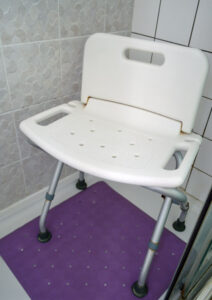
A white shower seat sits in a shower cubicle with a purple mat underneath

I honestly don’t know where I’d be without my shower seat now; probably unable to shower! It’s needed to save energy, since sitting takes less energy then standing, and also because my legs often give up on me after a short while standing and falling in the shower is not on my ‘to-do’ list! It also helps prevent me from getting dizzy – which is more likely to happen when standing – and subsequently fainting, again something I don’t fancy happening in the shower! My shower seat is one of those which is freestanding but also folds; this means when I stay somewhere away from home I can take it with me if the place I’m staying doesn’t already have a shower seat – if there’s no shower seat that means no showers for me while I’m away!

The mat is a fairly basic living aid – your bog standard anti-slip bath mat or in this case, shower mat! It helps me keep my footing when I get in and out of the shower cubicle and when I move from sitting on the shower seat to standing to get out etc.

The Grab Handles in the Shower
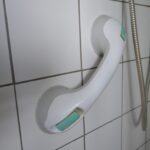
A white grab handle attched to bathroom tiles

For years I struggled with getting in and out the shower, holding onto the door frame or shower riser rail for support. But now we have suction grab handles in there; one on the wall to help with getting into the cubicle and on/off the shower seat and one on the shower cubicle door making it easier for me to open the door as there is only a small door knob on the inside to use to open it otherwise; something I can’t always grip! They make a huge difference to my ability to get into the shower, however the suction cups do sometimes come loose and we have learned it is often best to check them before each shower “just in case”! 

The Doorbell in the Shower
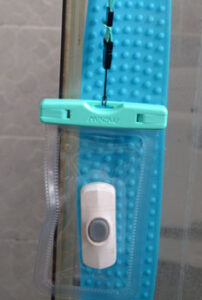
A doorbell in a waterproof smartphone bag, hanging from the doorhandle of a shower cubicleThis is a rather odd addition to my collection of aids, but as I am needing more help it has become essential to be able to get my parents attention when I am in (or ready to get out of) the shower. And so we came up with the mad idea of putting a doorbell in the shower cubicle which I could press to get help when I needed it, without having to shout to get my parents attention. 

In order for it to hang on the door handle I bought a waterproof smartphone holder; designed for using smartphones in wet conditions. The lanyard enables it to hang, while the bag protects it from the damp air. I hang it from the riser rail inside the shower and from the door handle outside when I’m not in the shower, as having it on the outside is also handy for those times I end up on the bathroom floor and need some help as I can reach it from there now too. We’ve had to set it to a tone that is VERY different from our front doorbell though as my parents were getting confused about which bell was ringing sometimes – this one now plays Jingle Bells when I push for assistance!

The Backscrubber
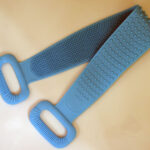
A bright blue silicone back scrubber

This is another recent addition to my collcection of aids; I’ve been struggling with washing my back since the muscles around my shoulders have strengthened through physiotherapy and are now holding the joints in place better (I never realised I was pulling them out a bit before!) So now I’ve bought myself a back scrubber to make that task a little easier again, it’s early days but so far it seems to be helping.

The Toothbrush Grip and “Easy Flosser”
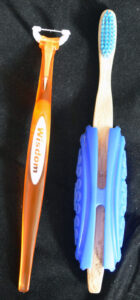
A long handled "easy flosser" and a bamboo toothbrush in a bright blue plastic grip

Another somewhat new thing; in my previous post about my essential aids to living I was using foam curlers on my toothbrush handle, but a little while ago I found a plastic grip specifically designed for toothbrushes and decided to give it a try. Now I can’t say it’s perfect – you have to be VERY selective about what toothbrush you buy as only certain shaped ones will fit in this grip – but it certainly works and unlike the foam curlers it can cope with getting wet, and doesn’t need replacing like they used to!

I also use a Wisdom “easy-flosser” which is basically a floss harp on a long handle, meaning I don’t have to try and grip the tiny floss strings – I have poor grip and weakness in my hands which mean that is incredibly difficult, at times impossible, for me. The easy-flosser takes some getting used to but has made my life a whole lot easier.

The Low-Height Mirror
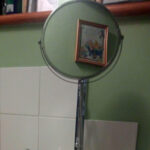
An adjustable, extendable shaving mirror attached to a wall

As I now I have to do things while sitting down rather than standing we have installed a mirror at a lower height so I can see what I’m doing when I’m sat at the sink doing my face or teeth. It’s such a simple thing but once again it makes a big difference to how easy/difficult a task is – have you ever tried flossing your teeth without being able to see what you’re doing? It’s not an easy task, especially with dexterity issues as well.

The Notice on the Bathroom Door
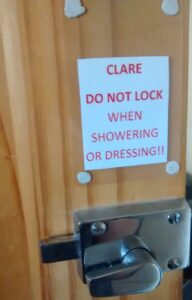
A white notice with red text readin "Clare Do Not Lock When Showering Or Dressing"

Now this one I blogged about on it’s own when it first came into existence back in 2015. The notice on the bathroom door is there simply to stop me from locking it when I am most at risk of falling. It reads: “CLARE DO NOT LOCK WHEN SHOWERING OR DRESSING!!”. It came about after many episodes where I had said I wouldn’t lock the door because of how unsteady I was on my feet, only to then automatically lock the door and cause a panic when my parents thought they heard me calling for help! The notice has to be fairly specific so that during times of particularly poor cognitive function I know I can lock the bathroom door when I am “just” using the bathroom, but also so other people know the notice doesn’t apply to them and they can actually lock the door since there is only the one bathroom in the house. The best thing about this notice is that it actually works! There have been many times over the years where I have automatically locked the door, only to then spot the notice and realise I need to leave it unlocked for my safety.
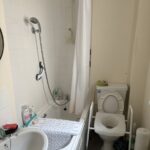
 

A small bathroom with bath, bath board across it and toilet with mowbray toilet frame visibleNow if you’re a regular reader of this blog or follower on social media you’ll know that a lot has changed since I first started writing this post – I moved out into a little accessible flat where for a time I was coping with a shower over the bath and low toilet setup, which included a bath board to sit on, suction grab rails, suction shower head holder & a Mowbray toilet frame. I was having to remove the toilet frame in order for there to be space for someone to help me into the bath to be able to shower.

I  was then very lucky to have a level access shower with shower seat, grab rails and a comfort height toilet. So for the first time in over a decade I was actually able to shower myself independently on good days. I have since been forced to move again, to another accessible flat in which the bathroom needs adaptations; the shower area although level access, is too small to use a shower seat in safely, the toilet is low and there’s no where to put any grab rails near it, in part because it’s so close to the door (in fact I can’t have the door closed when I use the toilet because should I fall no one would be able to get in to help me!). So currently I have a walking frame next to it acting as a grab rail! I’m waiting to hear what adaptations can be done and when. However I felt that leaving this post as it was with all the things I’ve used over the years might be helpful for others who aren’t so fortunate. I hope to do a post about the bathroom adaptations and any different aids I now use soon – depending on how long it takes to get my current bathroom adapted!

I honestly don’t know where I’d have been without these aids over the years, they have made life that bit easier and enabled me to keep a little of my independence while also keeping me safe. 

Share this:

The Importance of Silence

Silence is an important part of my daily life, to rest properly I need quiet. But I also need silence when I’m concentrating on things, particularly if whatever I’m doing requires a lot of concentration.

I recently had a phone appointment with one of the hospitals I’m under the care of, and right in the middle of it someone came into the room to tell me something. Rather than stopping what they were saying when they saw I was on the phone, they continued telling me whatever it was they wanted to say and as a result I missed an entire chunk of the conversation with the hospital. As it was happening I was trying so hard to concentrate on what was being said on the phone, as well as in the room, and I thought I would manage it, but literally seconds later it was blank. Not only did I blank what the hospital had been saying during that time when someone else was talking to me, but I also couldn’t tell you what the person in the room said to me either; I had some vague idea of what it was about but not the specifics. It’s as if my brain just shut down moments after trying so hard to take in both conversations!

At the time of this I was infuriated. Thankfully I did ask the hospital if they could send me a brief summary of the most important things discussed on the phone so that if I’d missed something really important it would be in there, and they were happy to accommodate that request. But that’s not the point.

However, it wasn’t until a few hours later that I remembered that not everyone has the difficulties I have in concentrating, or managing or following conversations on the phone. To this person, being able to take in a quick sentence about something else from someone else while they were on the phone was actually perfectly normal. But for me it is seemingly impossible.

So, like everything else in my life I thought I would blog about it, share my experience and the things I have to do to have some hope of following a conversation on the phone (and remembering it!) but also just generally being able to concentrate when doing things like watching TV, reading a book, or even typing this blog post!

I honestly don’t know how to properly explain what happens if I don’t do certain things in silence, but basically its as though if there’s more than one thing going on, competing for my attention, my brain shuts down and I can’t concentrate on any of the things going on.

So however troublesome it might be I have to have silence when I’m on the phone, or doing anything which requires concentration. Some examples include:

When the phone rings:

    • If I’ve got the TV on, I pause or mute it. Music or radio? Same thing.
    • If I’m out in the garden and it’s breezy, or other people are talking in the background, I have to go inside and find somewhere quieter.
    • If I’m in the house and people are talking in the same room as me, no matter how quietly, I have to go to a different room.

When I’m trying to concentrate:

    • If the TV is on, I’ll mute it or turn it off – it all depends on what I’m doing and how long it will take.
    • If the radio is on or there’s music playing, it usually has to go off or on a really good day providing it’s the only background noise and what I’m doing doesn’t require too much concentration it can stay on quietly (and by quietly I mean very quietly – my parents say they can’t hear it properly at the volume I can tolerate it on at while concentrating)
    • If I’m in the house and people are talking in the same room as me while I’m trying to do something which requires quite a bit of concentration, like reading a book, no matter how quietly they are talking, I have to go to a different room or stop what I’m doing until it is quiet again.

The truth is that when it comes to activities other than talking on the phone, it all depends on the level of concentration required and how I am that day as to whether complete silence is needed or whether I can cope with a little bit of background noise. For example most days when I am able to do some knitting I can manage to knit while the TV is on, or there is music in the background; providing it isn’t a complex pattern! However, I can only ever read a book when it’s quiet and there is no noise in the background except the hum of the fish filter or heating etc. anything beyond that and my concentration just vanishes so I have to put the book down.

Whenever someone visits, they’ll usually find I turn off the TV, radio or music, if it’s on, despite them saying it’s fine to leave it on. This is because my brain can’t filter out the conversation from the background noise, believe me I have tried. For short conversations I can usually cope, but anything longer than 30 minutes and my ability to concentrate on what is being said vanishes and not only am I unable to follow what is being said and join in the conversation, but it also uses a lot more energy! So if I know someone will be here longer than that I’ll opt to turn off anything in the background so I can participate in the conversation and pace myself better.

On a similar topic the other thing I can find difficult is multiple conversations going on within a small space; for example if we had say two members of my family come over for a cuppa and one is having a conversation about one subject with my parents and the other is talking to me about something entirely different, after a short time I struggle to concentrate and keep track of what is being said to me and think of a response because I can no longer block out the sound of the other conversation and my brain essentially tries to follow both at once and fails miserably! Usually in these situations I just quietly withdraw from the conversation entirely, not because I want to, but because I can’t manage to join in any longer.

I’m sure there are many other things I now do instinctively in order to be able to concentrate on things, stuff which most people wouldn’t think was necessary in order to be able to complete basic tasks. But alas for me silence is necessary, some days it just makes it easier to pace myself; it allows me to do that little bit more than if I had background noise to cope with as well, other days it is necessary if I am to do something which requires concentration. However, for some reason, I assume because it requires so much more concentration but I don’t actually know, I always need silence when I am on the phone if I am to be able to follow the conversation and remember what is said.


Share this:

Third Party Authority with Banks

For years I have struggled to manage my finances for myself; by that I don’t mean keep track of spending etc. I mean the actual physical side of banking, you know how someone gives you a cheque for your birthday and you have to go into your bank branch to pay it in? (because in some, if not all banks now no one else can pay it in for you) How you need some cash to pay for things/pay people back for things but are physically unable to get to an ATM? That’s the side of my finances that has been a struggle.

It wasn’t until recently that I learned banks actually offer a service to help you with this kind of thing. I know I became housebound as a kid, just before I hit my teens, but becoming housebound, chronically ill or disabled doesn’t come with a handbook which tells you everything that’s there to help you. (Or at least if it does I’ve missed out on that particular read!) It’s only when someone suggested it for an elderly relative of mine that it occurred to me to at the very least look into it, if not get it sorted for myself too; if I could that is.

Banks, in the UK at least, offer something known as Third Party Authority. Which allows you to give a person you trust access to your account; you can pick which services they are allowed to manage when you set it up; usually the options are a debit card for the account, telephone banking and online banking. Meaning that you no longer have to struggle to make that phone call, or go into branch yourself to deal with any financial matters that arise, instead the person you have delegated authority to can do so for you.

As I say it’s something I didn’t realise existed, something which would have been handy to have set up for myself years ago. But it’s only during this strange year of 2020 that I have actually done it. I don’t know whether it varies between banks, but I had the choice to set it up via phone, video call (if I had the mobile app) or in branch. Despite the pandemic I opted to do so in branch; phone calls are not my strong point, particularly when the chances are it would take a while to get through, so I figured I might as well use a similar amount of energy and go into the branch, getting some fresh air on the way!

I had to wait a little while when I got to the bank as it was quite busy, and with COVID-secure measures in place they can only have a certain number of people in the branch. But it probably wasn’t much longer than 30 minutes; they took my mobile number and phoned me just before they were ready for me meaning we could go have a wander round or cup of coffee while we waited for a member of staff to become available to help us.

Once in there, it took all of fifteen, maybe twenty minutes to get it all set up. Okay, so by “all set up” I mean all the forms filled out and details taken; the member of staff did all the form filling, we just had to check it all over before signing them. It then takes a few days to go through their accessibility team and the appropriate details to be sent to the person with delegated authority (by that I mean login details for online banking or a debit card and pin number, depending on which services you’ve opted to allow).

But from there on things should be a little easier being housebound. And anything that makes life even a tiny bit easier when you’re unwell is a good thing.

I wish I’d known about this years ago. It would have made life so much easier! That’s why I thought I’d blog about it; if this post makes just one person aware of this option then it’ll have been worth writing. Although perhaps I’m unique in not having known about this prior to recently? Perhaps there’s some sort of search I should have done when I became housebound which would have highlighted this as an option for someone who has become housebound? Anyway, hindsight is a wonderful thing and maybe now I’ll go looking for what other help is available and you never know I might just blog about something else I find….watch this space!

Share this:

What is a low energy activity?

If you’d have asked me that 10 years ago  I’d probably have said watching TV, having a shower, reading a book, doing homework, playing on the PlayStation. I’d also have said high energy activities were walking to school, going on the dance mat, walking into town, playing sports etc.


But I’d have been wrong; or at least I’d be wrong about what a low or high energy activity is for a person with chronic illness.


You see for someone with chronic illness even simple tasks can be classed as a high energy activity. Walking from one room to another. Sitting up for ‘long’ periods (sometimes a long period can be as short as 5 minutes). Showering. Dressing. Watching TV. Having a conversation. Using a computer. Drawing, writing, painting. Studying. Making a cup of tea. Making a quick snack. Knitting. And so much more.


Therefore low energy activities are hard to come by; listening to music, colouring in a colouring book, watching a DVD you’ve seen a thousand times before, texting a friend, lying out in the sunshine, listening to a TV show but not watching it. It’s hard to think of much else. If you have any suggestions please leave a comment!


This makes managing energy levels incredibly challenging; when most activities can be classed as requiring high energy it can be difficult to fill the day. Although it’s possible to do more than one high energy activity a day, in fact it’s often necessary to do so, it requires significant rest periods between them.


And by rest periods I mean complete rest. No stimulation. Deep, meditative breathing. Lying down but not going to sleep. Perhaps listening to some gentle music.

Managing a life with such limited energy while carrying out simple everyday tasks, let alone having some fun and achieving what some people wouldn’t even think about, is incredibly difficult. But for many of us it’s necessary. I hope by writing this it helps people understand just how difficult it can be to manage activity levels with such limited energy.

Share this:

Page 1 of 2

Powered by WordPress & Theme by Anders Norén